2013/08/11

七夕まつり | Tanabata Festival

"Sendai Tanabata"
This past week my wife and I traveled to her hometown, Sendai, to spend time with family and to give me my first chance to enjoy the famous Sendai Tanabata Festival (仙台七夕まつり "Sendai Tanabata Matsuri") together with them. The festival of Tanabata is celebrated throughout Japan at slightly different times, most commonly on July 7th (7/7), but not everywhere. The festival in Sendai is particularly famous and known by people all over the world. In Sendai the celebration happens in early August, which is more closely aligned with the original date of the festival (since many centuries ago it was scheduled on the lunar calendar).

Tanabata is a Star festival dating back to the mid 700s and was originally inspired by the annual "Qixi" star festival in China which is even older. While I've never heard of a festival in Japan that I find uninteresting, the history of this joyous festival is particularly charming and in some ways heartbreaking. It started back in ancient times when the goddess Orihime (織姫), or "Weaver Princess" would weave beautiful textiles while sitting on the banks of the "Milky Way" River. Her father Tentei (天帝), the Sky Emperor (a.k.a. the Universe), thought they were the most beautiful textiles in all of creation and cherished them greatly, so the princess kept very busy, diligently weaving her fine fabrics for him. In her devotion to her work, Orihime became lonely for companionship and became saddened by the idea that she may never fall in love. Although by virtue a very strict god, fatherly compassion for his daughter led Tentei to the idea that he could perhaps introduce his daughter to someone, so he did. When Orihime met Hikoboshi (彦星) the Cow Herding god, the two fell in love at first sight and were married soon after. The two were so in love that they neglected their work to spend time together. Orihime spent no time on her weaving, and Hikoboshi's herd of cattle ended up wandering all over the universe. Seeing this, Tentei became furious and brought down divine punishment upon them, separating the two forever and allowing them to never meet again. So great were Orihime's tears and deep sadness, that Tentei could not go on without extending to his daughter at least a tiny token of kindness. He promised her that so long as she worked hard on her weaving, she could be allowed to reunite with her husband on 7th day of the 7th month. Even now, in modern times, this heavenly cycle continues the same as it has through the centuries, and on the 7th day of the 7th month each year, Orihime and Hikoboshi are allowed to be together all day. So joyous is the occasion that all of us humans celebrate along with them and share in their happiness.

In Sendai, a considerable amount of effort goes into the planning and preparation. Huge bamboo trees are felled and stood in the streets to be decorated with many different kinds of decorations. Primarily, the first thing that one notices are the massive, brightly colored tanabata streamers called Fukinagashi (吹き流し) which hang down from high above just like the threads of Orihime's weaving. The Fukinashi stream from the bottom of large Kusadama (薬玉) which are typically in the shape of a ball and lavishly decorated. The word Kusadama literally means "medicine ball," but I don't know how these got their name to be honest. Additionally, the trees are adorned with:
  • Tanzaku (短冊) which are strips of paper upon which you write a wish in hopes of getting some divine assistance.
  • Kinchaku (巾着) which is a paper purse and in its symbolism will help to encourage prosperity in business.
  • Toami (投網) are nets which bring a bountiful catch and harvest to fishermen and farmers.
  • Kamigoromo (紙衣), or paper kimono. Symbolic of Orihime's weaving, they help to ward off poor health and help to inspire craftsmanship.
  • Orizuru (折り鶴), or origami cranes, which help to bring good health and long life.


The start of the festival is marked by a fireworks display and a parade, and then continues for three days. The way to celebrate Tanabata festival is to get together with your family and/or friends and head into the main downtown shopping district in Sendai where the festivities take place. The thing to do is stroll the streets at your own pace, taking in all the scenery and festive atmosphere. The streets are lined with food, drink and souvenir vendors, as well as traditional festival games. Girls and young ladies are often dressed in colorful yukata (traditional Japanese summer-weight clothing), and some people occasionally find their own original ways to celebrate as well, for example with a crazy costume.

Me with "Nast Samurai"
which when spoken with a Japanese pronunciation says
 茄と侍 or "Eggplant and Samurai." LOL!

2013/05/18

Eye exams in Japan

eye exams in Japan

A couple of weeks ago the time had come when my supply of contact lenses ran out, which meant it was time for another visit to my local healthcare professionals. Despite the fact that my first experience went so smoothly, the second time did not come without that familiar feeling of nervousness and intimidation. Would I be able to understand the doctors? Are eye exams in Japan different than American ones? Just like the first time around, I had no choice but to go and find out.

I rode my bicycle 5 minutes to Ueno (上野) where I had seen several eyewear shops, and decided to walk around a little bit. About 3 minutes into my walk, I spotted a guy holding a signboard and passing out flyers. The sign was for a business called プライスコンタクト (Price Contact) and adveritised a discount for first time customers. I had read about Price Contact on the internet several weeks before and there were some good reviews about it being no-frills and inexpensive while maintaining quality and professionalism. "何て素晴らしい偶然だ!" (what a splendid coincidence!), I thought. I went up to the guy and asked him if I could also get an eye exam there, and he told me I could and showed me one of his flyers which detailed the many familiar brands of contacts they sell. The flyers also included a discount coupon. I asked him where the shop was located and he guided me the short distance to the shop, called the elevator and held the door open for me, and directed me to the 5th floor of the building.

The 5th floor looked a bit like a small warehouse and not at all like an optometrist's office so I had to ask myself if I had gotten off on the wrong floor. There was only one other person there, but I saw them being handed a bag with the Johnson and Johnson Acuvue logo on it so I concluded I must be in the right place. I spoke to the attendant who asked me if it was my first visit and inquired as to whether I have insurance. I told her it was my first eye appointment in Japan ever and that yes, I do have insurance. She gave me a short form to fill out which was primarily about my contact lens usage history; it took me a little over 5 minutes to fill out. She looked over my form and seeing that I learned about the shop from a flyer, asked me if I had a discount coupon. I gave her the coupon and after putting it into my file she gave me a print-out with my info on it and directed me up to the 6th floor.

The 6th floor was a bright and spotlessly clean eye doctor's office, except unlike others I had been to before was bustling with medical staff and other customers. I handed my paper to the receptionist and she invited me to put my backpack on a nearby shelf and have a seat. I sat for about 2 minutes before I was approached by one of the technicians. She got right to work asking me about the kind of lenses I usually wear and about my general eyesight history. After explaining my options in a way that was very easy to understand, she helped me select the kind of lenses I wanted. After deciding on Cibavision Air Optix 2-week disposable lenses, we moved on to the vision test.

視力検査 (shiryoku kensa / eye exams) in Japan are slightly different from American ones. They start with a machine that to me seemed like little more than a large, monoscopic viewmaster with a photo of a hot air balloon in it. When I was asked to look into the eye piece, the photo was really blurry at first, but the machine made some automatic adjustments until the photo was almost perfectly clear. This was done once for each eye. The technician took some readings from the machine and directed me to a different area of the office. The next part of the exam was slightly more familiar but also unfamiliar as well. I was seated on a stool facing a projection of an eye chart, making it feel pretty much just like the eye exams I'd been given since my childhood. The primary difference is that in Japan, eye doctors don't use that eye chart with like big letter E at the top and the rows of letters that get progressively smaller further down the chart (which I subsequently learned is called a Snellen Chart). After all, the roman alphabet is not used in Japan so that wouldn't work too well. Here, optometrists use the Landolt C chart, also know as a Japanese Vision Test. This kind of chart uses rows of circles in which a small piece from one side of each circle is missing and you tell the doctor which part is missing-- up, right, left, down. When a "C" is too small for one's eyes to see, it pretty much just looks like a blurry ring. I had to cover one eye and view different parts of the chart, then repeat with the other eye. After this came the part where I put my face against a giant pair of steel glasses with all sorts of contraptions attached to it, so that the technician could determine the correction I need. Aside from the hot air balloon viewmaster machine and the type of chart used, the vision test was the same as any other eye exam I've had.

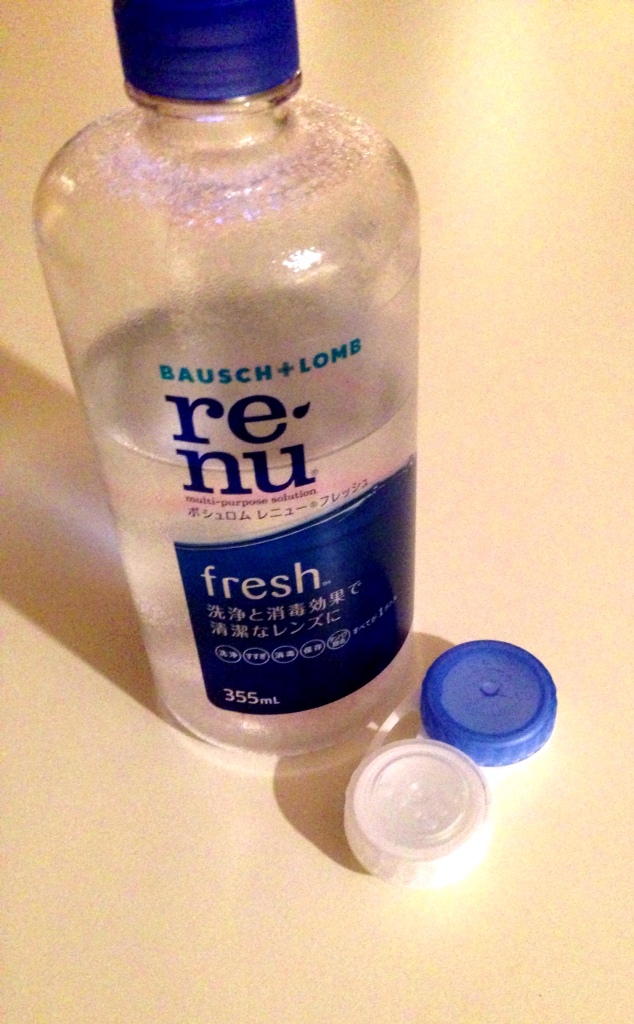
At the end of the vision tests a doctor examined my eyes directly, looking for any signs of trouble, which there were none. Finally, the technician discussed proper eye care and contact lens maintenance with me, and sought to confirm whether I was satisfied with everything, which I definitely was. I found that everything had gone perfectly well and that I pretty much had no trouble understanding. The only real problem was learning that my eyes had gotten quite a bit weaker since my last eye exam at the beginning of 2012. I checked out of the doctor's office and paid for my eye exam on the way out which, with my National Heath Insurance, cost ¥980, or about $10. They gave me a voucher so that I could collect my lenses back down on the 5th floor. I went back downstairs, received my new contact lenses and also took advantage of their discounted supplies as well. The National Health Care program doesn't cover contact lenses, but the cost was very reasonable anyway. For ¥9800, or about $100, I got a 6-month supply of contact lenses, and a 6-month supply of ReNu cleaning/storage solution and cases. I remembered that this is the cost I used to pay for the lenses alone back in Chicago!

The whole process took about 40 minutes, starting from walking in off the street with no appointment, to walking out with a new prescription and 6 months worth of contacts and supplies all for about $110. Pretty awesome! Thanks Price Contacts! Thanks again Japan National Health Insurance!


2013/05/01

First visit to the doctor

Clinica Kanda
http://www.clinica-kanda.jp

It's unavoidable that from time to time we all need to see a doctor, regardless of where we live. Recently I had my first experience with healthcare in Japan, so I thought it might interest my readers to find out what it was like.

It began when I started having some pain in my inner ear, accompanied by a sudden build-up of wax. Initially I thought I would just wait it out to see if it cleared up on its own, but when I woke up on a Tuesday morning to find that instead it had become worse, I knew I had an ear infection, and that it was time to have it checked out. Admittedly I was a bit nervous not knowing at all what to expect. As always, there was also fear of being unable to communicate clearly. I started thinking about the many pages of forms that I have always had to complete when going to see a doctor in Chicago, and I wondered how I would be able to understand all the Japanese medical and healthcare terminology. Something had to be done, though, so I had no choice but to figure it out.

First, after arriving at work, I emailed my wife for a little help since I didn't know which type of doctor I needed to see, nor which Japanese characters (kanji 漢字) are used for this. She taught me that for cases like mine, like in most countries, there are ear, nose and throat specialists, or jibi-inkōsenmon-i (耳鼻咽喉専門医). A quick internet search revealed that there was a jibi-inkōsenmon-i in the Tokyo neighbourhood, Kanda (神田), which is just a 4-minute walk from my office. I decided that I would walk over there diring lunch to check out the situation.

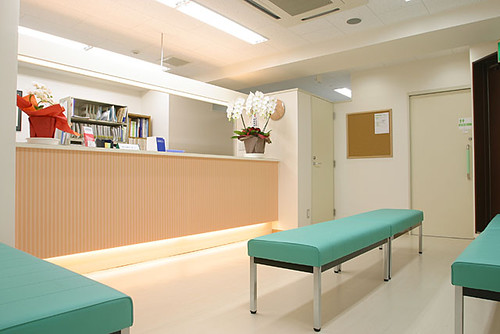
After a very busy morning at the office, which left very little time for an actual lunch break, I walked over to "Clinica Kanda" (クリニカ神田) in the mid-afternoon, and found a very simple, no-frills, somewhat institutional-looking but very clean doctor's office. I nervously stepped up to the reception desk and politely told the nurse that I wanted to see a doctor, apologising for showing up without an appointment. She was very friendly, assured me that my walk-in was perfectly fine, and after asking me if I could read Japanese, gave me a form to fill out.

I sat down and looked at the form, and I was a little bit taken aback! One page, large type, single sided! "Wow, really? Awesome!" I thought. A native Japanese person could probably fill it out in less than 1 minute; it took me about 4. I brought the form back to the nurse and after giving it a quick look-over she asked to see my insurance info. I pulled out my National Health Insurance Card (kokumin kenkō hoken cādo 国民健康保険カード) and presented it to the nurse. She asked me if it was OK for her to make a photocopy of it, to which I of course replies "yes." She came back after a few seconds, returned my card and invited me to have a seat.

I sat down and waited for about 3 or 4 minutes and was called back into the doctor's office! At this point in my post, I would like to remind my readers that I had no appointment and simply walked in off the street less than 10 minutes earlier. I certainly had no referral from a primary care physician or anything like that (because anyway there's no need for such a thing in Japan). As I was guided to the medical examination area, I reflected on going to see my doctor in Chicago several months earlier, and how the earliest possible appointment was 4 weeks out, and how after arriving on time I still had to wait close to 45 minutes before actually seeing the doctor. "What had happened just now? Why was this so easy? Is this perhaps the way it's actually supposed to be?" I wondered.

The doctor who I saw at Clinca Kanda is an older gentleman, definitely a no-nonsense kind of man, but at the same time quite friendly. I was shown to an examination table that was fitted with some of the latest ear, nose and throat specialist's technology. He examined my ears using a tiny video camera, complete with a monitor so that I could watch while listening to his explanation. I have to admit that seeing a computer monitor displaying live action footage of the giant waxball that had formed in my ear was a tiny bit on the embarrassing side (hahaha), but it was pretty interesting as well. The doctor took care of the immediate problem and then showed me the bright red blotch on my ear drum which is a classic ear infection symptom. While writing me a prescription for antibiotics, he explained their usage to me. He asked if I had any other questions and told me that if I still had pain after the meds run out I should come back.

The nurse showed me back out to the reception area where I was presented with my prescription and my bill-- ¥1,480 (about $15). Wait, really? Wow, ok, great! She then pulled out a map and gave me directions to the local pharmacy (which is actually inside a convenience store). It was right across the street, but despite that, being shown a map and given clear directions anyway is just part of customer service in Japan.

I crossed the street and went to the Natural Lawson convenience store, which is like a 7-11 version of Whole Foods. I walked into the pharmacy section and since it was my first time to see the pharmacist, I had to fill in a short form about meds I'm taking (none) and allergies I have (none). The pharmacist was super friendly, taking her time explaining the meds to me and how and when to take them. She also gave me some basic, general info about pharmacies in Japan. She filled the prescription and rang me up-- ¥500 (about $5).

So to summarise, I took a short walk to the local ear, nose and throat specialist, walked in without an appointment, filled out a sub-minimal amount of paperwork, received excellent care, paid about twenty bucks in total (which is what I used to pay just for my Blue Cross Blue Shield of Illinois pharmacy co-pay), and half an hour later was walking back to work with my immediate problem fixed up and medicine in my hand! What was I worried about again? By that time I had forgotten all about any concern that I had. Three days later my meds were all gone and so was my ear infection. Thank you Clinica Kanda, Natural Lawson and the *awesome* National Heath Insurance Program of Japan!


2013/04/09

Hanami / 花見

I do apologise, readers, because this post is late. Here in Tokyo we've already come to the end of the sakura (桜 "cherry blossom") season. In Tokyo, sakura start to bloom around mid-to-late March and reach their peak about 7 to 10 days later. The season starts earlier or later in the year depending on the region. It's important to note, also, that there are many different varieties of sakura, and they do not all start to bloom at exactly the same time. Once the flowers start to bloom, it is only about two to two-and-a-half weeks later that the blossoms begin to fall and the leaves start growing. Strong spring winds or rains have the potential to shorten the blooming cycle considerably. The time to enjoy them is short and fleeting, and from what I gather, this seems to be part of the appeal. Once the first cherry blossoms of the spring start blooming, a sakura blooming forecast becomes part of the daily weather report, so that everyone can plan for the arrival of the "Sakura front" in their area, and make the most of it.

During the time when the trees are blooming, people gather any place where there are high concentrations of cherry blossom trees and enjoy Hanami (花見). The word hanami literally means flower viewing, but when this word is used it's understood that the flowers being viewed are sakura. It is said that the first use of this word in reference to cherry blossom viewing occurred in the famous Heian period (平安時代 794 - 1185) novel, The Tale of Genji (源氏物語) by Murasaki Shikibu (紫式部).

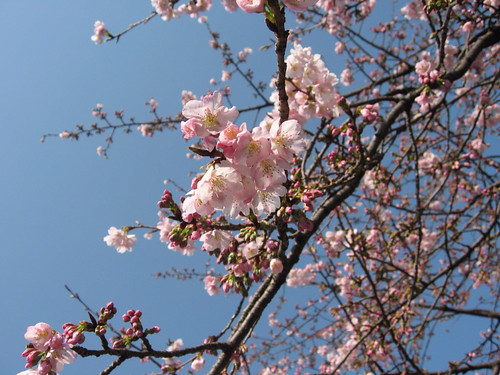
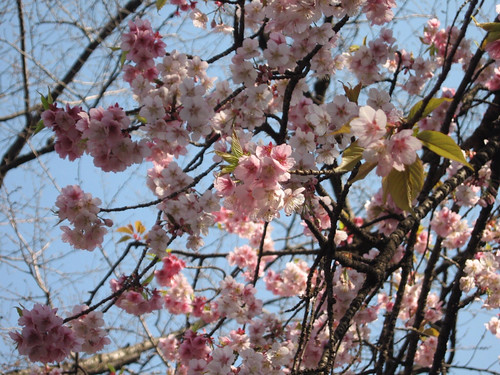
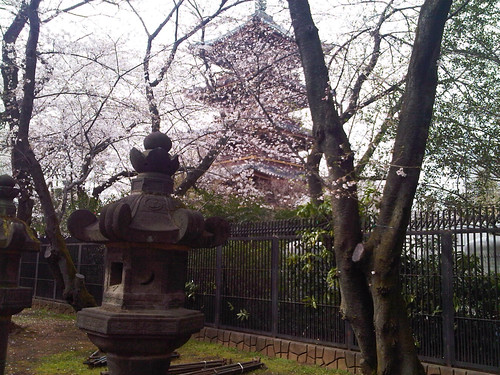
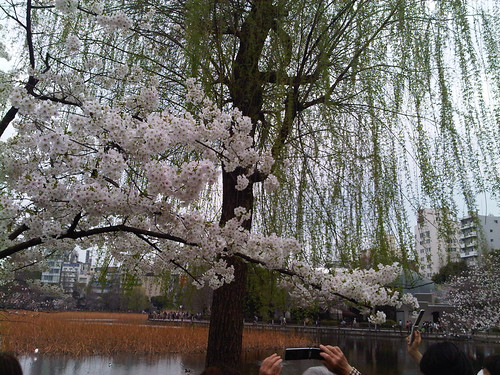
Yaezakura 八重桜It's well known that Japan is famous for sakura and since this year was my first time to actually see the trees blooming with my own eyes, I wanted to be sure and really enjoy it. Right at the start of the season, my wife and I went to historic Ueno Park (上野恩賜公園) which has been one of Tokyo's favourite hanami spots for hundreds of years. We mostly saw flower buds and blossoms just starting to open, but there was a small handful of trees that already looked incredible. These were yaezakura (八重桜) or multi-layered cherry blossoms which start flowering a little earlier then most.

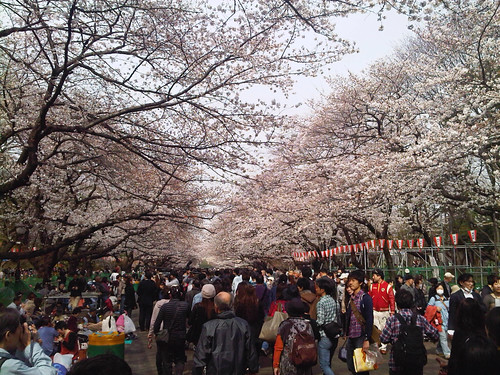
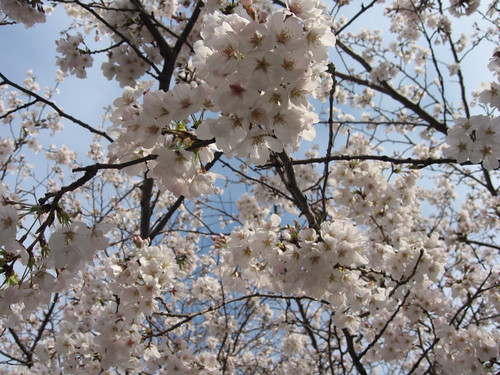
Ueno Park 上野恩賜公園A week later when we returned to Ueno Park, the trees, both yaezakura and the more numerous somei-yoshino (ソメイヨシノ), were in near full splendor. There must be well over 100 trees lining either side of park walkways, and to say that it was breath-taking simply does not do it justice. The backdrop of Ueno Park's centuries-old history and beauty seemed to compliment the freshness and fragility of the blooming cherry blossoms. The air seemed to be tangibly filled with energy both from the blossoms themselves as well as from all of the many hanami-goers. Lots of street-food vendors come out for the occasion to cater to the many thousands of park visitors, which adds to the festive atmosphere. Groups of friends and family gather under the trees for picnics, which apparrently sometimes begins with folks arriving several hours in advance to reserve their favourite spot! Since I first started visiting Tokyo 10 years ago, Ueno Park has always been a treasured spot, but now I have even more reasons to love it.

Ueno Park 上野恩賜公園 Ueno Park 上野恩賜公園


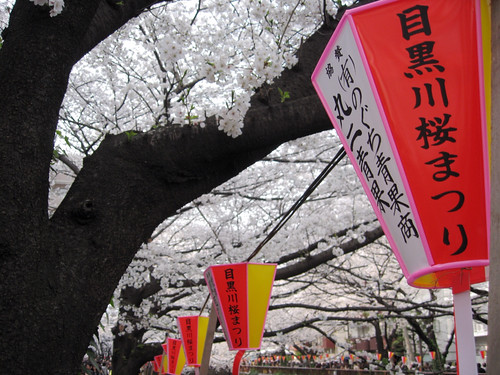
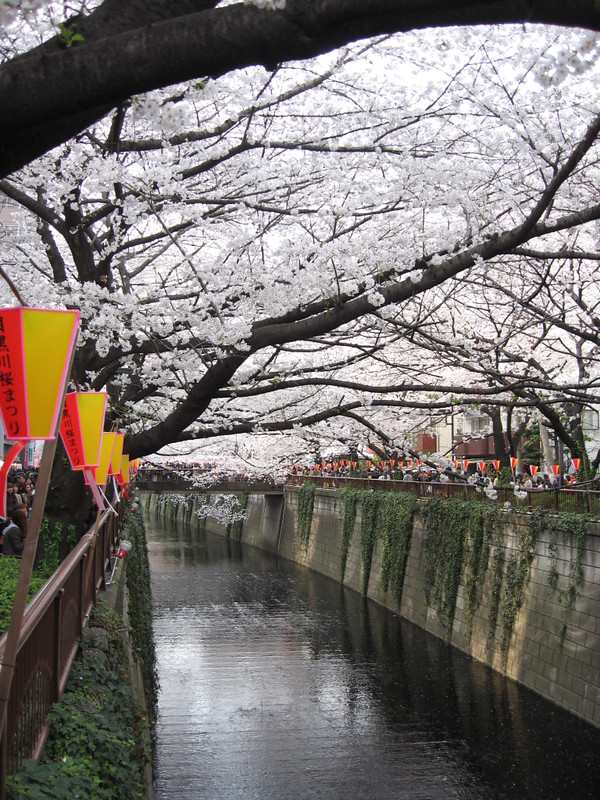
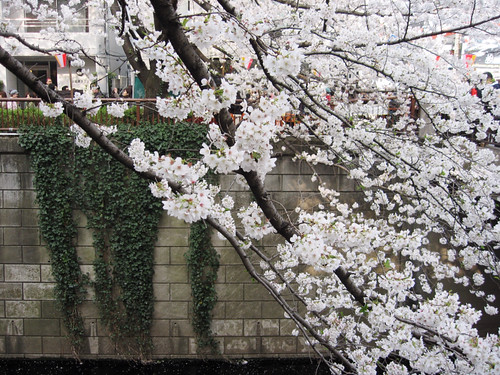
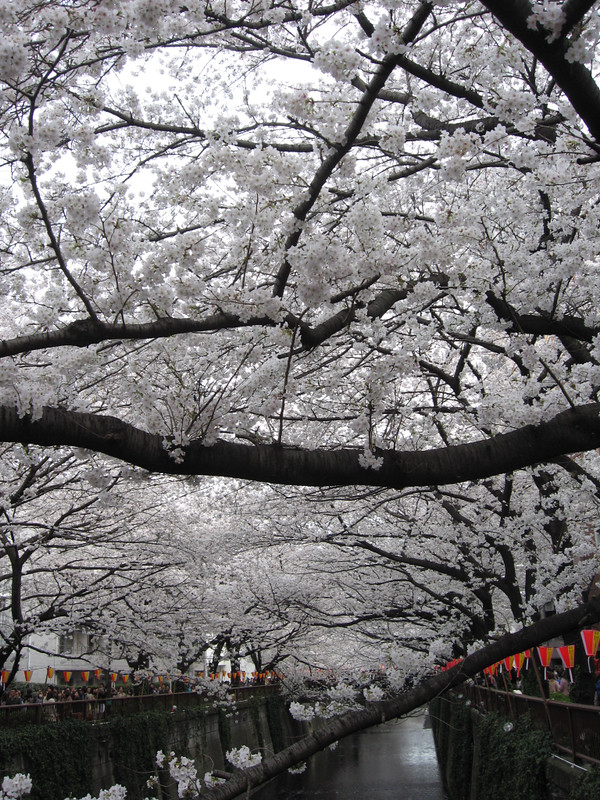
Meguro River 目黒川The following weekend, when the cherry blossom trees were at their peak, my wife and I were invited for hanami in our friend's neighbourhood, Meguro (目黒) which has another legendary hanami spot, Meguro River (目黒川). Here, as the name suggests, the trees grow along each side of a long river forming a canopy over it, which is clearly a recipe for some gorgeous scenery. Here as well, the trees are so numerous that views of anything else in the surrounding area are somewhat obscured. The blossoms thickly covered the branches which lended to an appearrance reminiscent of snow-covered boughs. Sakura petals fell in a spring flurry, and fluttered down into the river below to be carried off downstream. Sakura-scented champage was sipped, hawaiian doughnuts were eaten (ok, that part is not so traditional, but they were delcious!!) and it was a moving experience overall.

Meguro River 目黒川 Meguro River 目黒川 Meguro River 目黒川

It will be another incredible experience again next year, I'm sure, now that I'm a seasoned hamami professional (haha, yeah- right). Have any of my readers been to Japan for cherry blossom season? Perhaps some of you live and/or grew up here? I would love to hear about your favourite spot(s)!